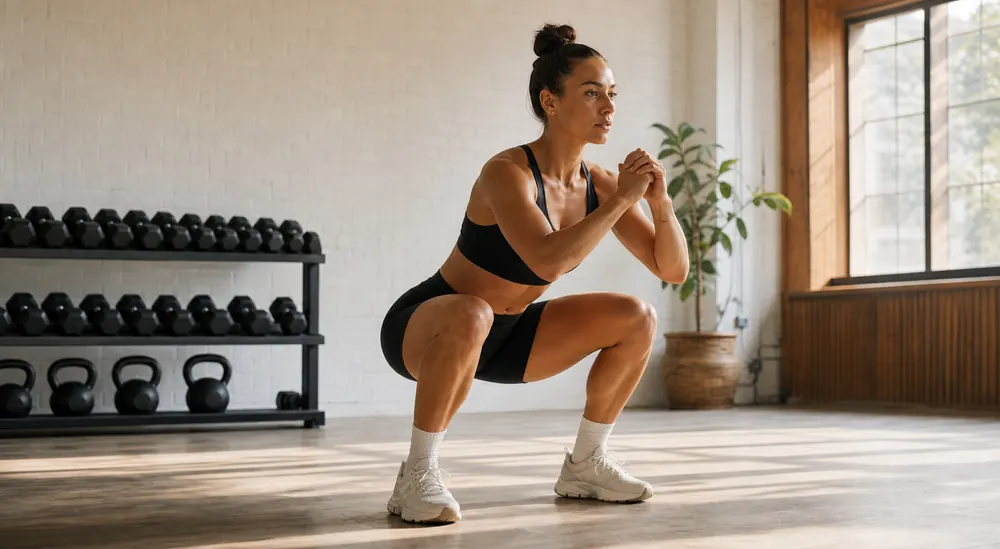
What a camera can see in a strict press
A strict press drives the bar from the front rack to overhead using the arms and shoulders alone. Because the defining feature is the lack of a leg dip, the identity gate watches the knees and the hips: any bend past a small tolerance, or any vertical hip travel, means the rep was a push press or a jerk and the clip is not scored as a strict press. What the rubric then scores is the elbow angle at the finish and how far the trunk leans back to get the bar past the head — the strictest torso threshold of any movement in the library.
How ScoreRep scores a strict press
The rubric declares 4 scored criteria. The strongest single camera angle is the left side view. Every criterion below is available from that angle.
The score is the points earned divided by the points the recorded angle could support, so a clip filmed from a limited angle is never quietly marked down for what the camera could not see. At least 60% of the applicable weight has to be measured before a result is ranked at all.
| Criterion | Points | Measured from the athlete’s pose | Full marks when |
|---|---|---|---|
| Overhead lockout | 35 | elbow angle in the finish position | 165° or more |
| Neutral torso | 30 | largest torso lean away from vertical | 10° or less |
| Control | 20 | ratio of lowering time to lifting time | 0.8 or more |
| Consistency across the set | 15 | drop in rep speed between the fastest and the slowest rep | 10% or less |
Criteria that depend on the camera angle
These criteria are excluded, not estimated, when the recorded angle cannot support them. That is why the same set filmed twice from different positions can produce two valid scores out of two different totals.
- Neutral torso — needs a left side, right side, left oblique and right oblique view.
Does this strict press rep count?
ScoreRep answers that in two separate steps. First, the clip has to read as a strict press at all: every check in the table below has to pass, and a reading the camera could not take counts as a fail, never as a pass. A clip that fails is returned unranked with the reason attached, rather than scored low against the wrong rubric, and no template can override a failed check.
Second, the scoring criteria award points. Falling short of a full-marks threshold costs points, not the rep. Every number here is read from version 2 of the strict press rubric, the same file the scoring engine runs.
- Compare the strict press standard with the other 29 movements on the movement standards page.
- How the rep counter decides between a valid rep and a no-rep, station by station.
| Reading | Has to be | Otherwise rejected because |
|---|---|---|
| Whether the hands finish above the shoulders | yes | the bar never reaches an overhead position |
| Smallest knee angle in the rep | 155° or more | the knees bend, which reads as a push press or push jerk rather than a strict press |
| Vertical travel of the hips across the rep | 0.04 or less | the legs and hips contribute, which reads as a push press or a jerk rather than a strict press |
| Elbow angle in the starting position | 120° or less | the bar is not in the front rack at the start |
What the recording has to contain
Eligibility decides whether a result can enter a leaderboard. Failing it does not block the feedback — the clip is still scored and returned, but marked unranked with the reason attached, so a bad camera position never silently becomes a bad score.
- A pose has to be detected in at least 55% of the frames.
- The camera angle has to be one of: left side, right side, left oblique, right oblique, front and back.
- At least 1 complete repetition has to be detected.
What is deliberately not scored
Identity, repetition counting, eligibility and the score are derived only from the athlete’s pose. Measurements that come from tracking an external object — the path of a barbell, for example — are drawn on the review overlay but are deliberately outside the scoring contract, so they never affect the number.
Reading the result
A falling torso score across a set of strict presses almost always arrives before the lockout score does: the athlete leans back to keep pressing once the shoulders fatigue. Watching the two together tells you which rep of the set was the last honest one, which is more useful for programming than the total count. If the identity gate rejects the clip, the set was a push press — that is not a failed rep, it is a different lift, and it has its own page.
A technique score is educational feedback about visible movement. It cannot tell you whether a load is safe for your joints, whether pain means something, or whether a programme suits you. Those judgements need a coach or clinician who knows your history.