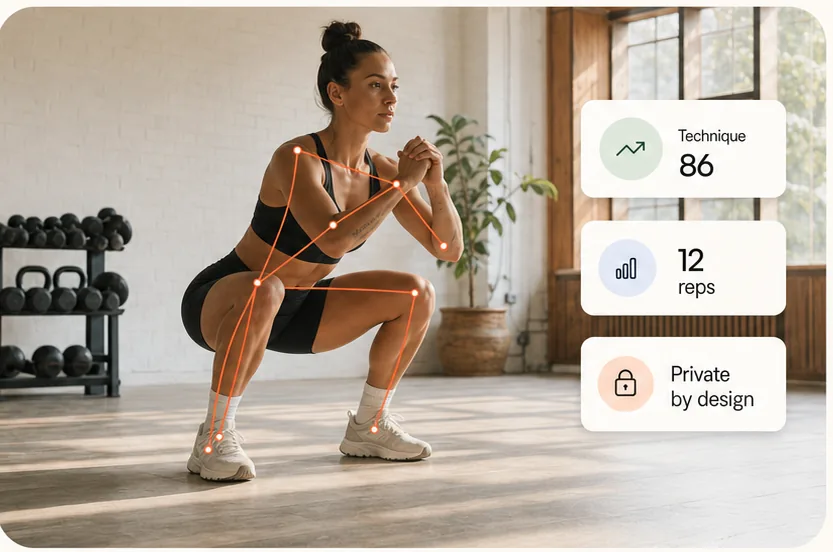
1. Confirm the clip contains the selected movement
Each supported exercise has a movement signature. The signature checks visible ranges and key positions to reduce the chance that a similar exercise is scored under the wrong rubric.
The analysis also requires enough pose frames, a supported camera view and at least the required number of detected repetitions.
2. Segment the movement into repetitions
Pose landmarks are processed across time to identify movement phases and key moments such as the bottom of a squat, a catch or a lockout. Rep segmentation allows the system to evaluate a set rather than one isolated image.
3. Apply exercise-specific criteria
Criteria are defined per exercise and weighted to a total technique score. A back squat covers depth, torso position, knee alignment, symmetry and timing — the bar path is drawn on the overlay but never scored; a wall ball uses a different set covering the squat, throw and cadence.
Criteria that require a view not present in the recording should not be treated as equally observable.
4. Preserve uncertainty and limitations
Two-dimensional pose estimation does not directly measure force, muscle activation, pain, tissue loading or medical safety. Clothing, lighting, camera perspective and occlusion can affect landmark quality.
ScoreRep is an educational review tool. Results should be checked against the original video and, where training decisions matter, discussed with a qualified professional.
How the method applies to individual movements
The same four steps produce visibly different rubrics once they meet a specific exercise. The squat review leans on depth and bar path, the deadlift on the hinge and lockout, the wall ball on the throw cycle, and the burpee on completing a floor-to-standing range at a repeatable cadence. Reading one of those pages alongside this method is the quickest way to see which criteria a given camera angle can actually support.