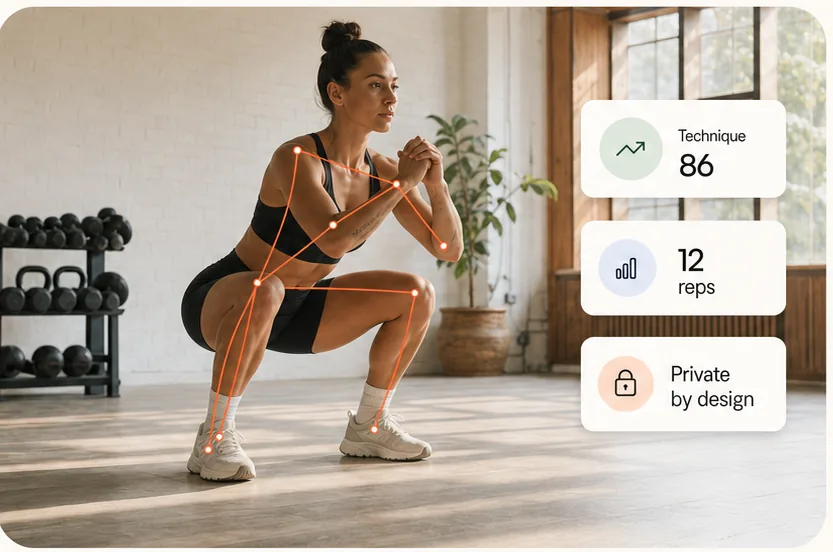
How to read a movement standard
Each row answers two questions. "Counted as the movement only if" lists the movement checks: every one has to pass for the clip to be treated as that movement, and a reading the camera could not take counts as a fail. A clip that fails is returned unranked with the reason, not scored low.
"Full marks when" lists the top band of every scored criterion. Falling short of one costs points, not the rep. Each movement page shows the full bands and which camera angle each criterion needs.
Angles are measured at the joint, so a smaller knee angle is a deeper position and a larger elbow angle is a straighter arm; 180° is fully straight. Ranges of travel are relative distances measured in the video frame, not centimetres, so they compare clips filmed from the same position rather than describing a box height.
Barbell strength standards
Select a movement for its full rubric and camera guidance, or check a set of your own against the same thresholds.
| Movement | Counted as the movement only if | Full marks when | Your reps |
|---|---|---|---|
| Back Squat | vertical travel of the hips across the rep: 0.08 or more; whether the hip crease passes below the knee: yes; whether the hands finish above the shoulders: no | Depth — smallest knee angle in the rep, 95° or less; Knee alignment — narrowest knee-to-ankle width ratio (under 1 means the knees track inside the feet), 0.95 or more; Torso position — largest torso lean away from vertical, 30° or less; Left-to-right symmetry — largest left-to-right difference in knee angle, 5° or less; Lowering-to-lifting control — ratio of lowering time to lifting time, 1 or more | Check your back squat reps |
| Deadlift | vertical travel of the hips across the rep: 0.06 or more; largest hip angle in the rep: 150° or more; whether the hands finish above the shoulders: no; smallest knee angle in the rep: 100° or less; torso lean in the starting position: 20° or more | Back position — largest torso lean away from vertical, 60° or less; Hip hinge — smallest hip angle in the rep, 70° or less; Lockout — largest hip angle in the rep, 170° or more; Left-to-right symmetry — largest left-to-right difference in knee angle, 6° or less | Check your deadlift reps |
| Front Squat | vertical travel of the hips across the rep: 0.08 or more; whether the hip crease passes below the knee: yes; whether the hands finish above the shoulders: no; elbow angle in the starting position: 120° or less; knee angle in the finish position: 150° or more | Depth — smallest knee angle in the rep, 95° or less; Upright torso — largest torso lean away from vertical, 20° or less; Lowering-to-lifting control — ratio of lowering time to lifting time, 1 or more; Left-to-right symmetry — largest left-to-right difference in knee angle, 5° or less | Check your front squat reps |
| Overhead Squat | vertical travel of the hips across the rep: 0.08 or more; whether the hip crease passes below the knee: yes; whether the hands finish above the shoulders: yes; elbow angle in the finish position: 155° or more; vertical travel of the wrists across the rep: 0.15 or less | Overhead lockout — largest elbow angle in the rep, 165° or more; Depth — smallest knee angle in the rep, 95° or less; Upright torso — largest torso lean away from vertical, 20° or less; Left-to-right symmetry — largest left-to-right difference in knee angle, 4° or less | Check your overhead squat reps |
| Push Press | whether the hands finish above the shoulders: yes; vertical travel of the hips across the rep: 0.03 or more; smallest knee angle in the rep: 115° or more; elbow angle in the starting position: 120° or less; knee angle in the finish position: 150° or more | Overhead lockout — elbow angle in the finish position, 165° or more; Leg drive — time taken by the lifting phase, 0.7s or less; Torso stability — largest torso lean away from vertical, 15° or less; Eccentric control — ratio of lowering time to lifting time, 0.6 or more | Check your push press reps |
| Romanian Deadlift | vertical travel of the hips across the rep: 0.05 or more; whether the hands finish above the shoulders: no; smallest knee angle in the rep: 110° or more; largest hip angle in the rep: 150° or more | Hip hinge — smallest hip angle in the rep, 60° or less; Back position — largest torso lean away from vertical, 60° or less; Softly bent knees — smallest knee angle in the rep, 140° to 175°; Eccentric control — ratio of lowering time to lifting time, 1.2 or more | Check your romanian deadlift reps |
| Strict Press | whether the hands finish above the shoulders: yes; smallest knee angle in the rep: 155° or more; vertical travel of the hips across the rep: 0.04 or less; elbow angle in the starting position: 120° or less | Overhead lockout — elbow angle in the finish position, 165° or more; Neutral torso — largest torso lean away from vertical, 10° or less; Control — ratio of lowering time to lifting time, 0.8 or more; Consistency across the set — drop in rep speed between the fastest and the slowest rep, 10% or less | Check your strict press reps |
| Thruster | vertical travel of the hips across the rep: 0.07 or more; whether the hip crease passes below the knee: yes; whether the hands finish above the shoulders: yes; elbow angle in the starting position: 120° or less; smallest knee angle in the rep: 110° or less | Rack position — elbow angle in the starting position, 95° or less; Squat depth — knee angle at the bottom of the rep, 100° or less; Leg drive — time taken by the lifting phase, 0.9s or less; Overhead position — elbow angle in the finish position, 165° or more; Fluency — repetitions completed per second, 0.5 or more; Left-to-right symmetry — largest left-to-right difference in knee angle, 6° or less | Check your thruster reps |
Olympic lifting standards
Select a movement for its full rubric and camera guidance, or check a set of your own against the same thresholds.
| Movement | Counted as the movement only if | Full marks when | Your reps |
|---|---|---|---|
| Clean & Jerk | vertical travel of the hips across the rep: 0.1 or more; whether the hands finish above the shoulders: yes; vertical travel of the wrists across the rep: 0.2 or more; smallest elbow angle in the rep: 100° or less; elbow angle in the finish position: 155° or more | Overhead lockout on the jerk — elbow angle in the finish position, 165° or more; Hip extension — largest hip angle in the rep, 172° or more; Front rack on the catch — elbow angle at the catch or bottom position, 95° or less; Explosiveness — time taken by the lifting phase, 0.8s or less; Left-to-right symmetry — largest left-to-right difference in knee angle, 5° or less | Check your clean & jerk reps |
| Hang Power Clean | vertical travel of the hips across the rep: 0.05 or more; largest hip angle in the rep: 155° or more; whether the hands finish above the shoulders: no; elbow angle in the finish position: 100° or less; smallest knee angle in the rep: 100° or more; torso lean in the starting position: 20° or less | Hip extension — largest hip angle in the rep, 172° or more; Power catch — knee angle at the bottom of the rep, 140° or less; Front rack elbows — elbow angle at the catch or bottom position, 95° or less; Explosiveness — time taken by the lifting phase, 0.7s or less | Check your hang power clean reps |
| Hang Power Snatch | vertical travel of the hips across the rep: 0.05 or more; whether the hands finish above the shoulders: yes; elbow angle in the starting position: 130° or more; smallest knee angle in the rep: 100° or more; elbow angle in the finish position: 155° or more; torso lean in the starting position: 20° or less | Overhead lockout — elbow angle in the finish position, 165° or more; Hip extension — largest hip angle in the rep, 172° or more; Power catch — knee angle at the bottom of the rep, 140° or less; Explosiveness — time taken by the lifting phase, 0.7s or less | Check your hang power snatch reps |
| Power Clean | vertical travel of the hips across the rep: 0.06 or more; largest hip angle in the rep: 160° or more; whether the hands finish above the shoulders: no; elbow angle in the finish position: 100° or less; smallest knee angle in the rep: 100° or more; torso lean in the starting position: 20° or more | Hip extension — largest hip angle in the rep, 172° or more; Catch in the rack — knee angle at the bottom of the rep, 140° or less; Front rack elbows — elbow angle at the catch or bottom position, 95° or less; Timing — time taken by the lifting phase, 0.8s or less | Check your power clean reps |
| Power Snatch | vertical travel of the hips across the rep: 0.05 or more; largest hip angle in the rep: 160° or more; whether the hands finish above the shoulders: yes; elbow angle in the starting position: 130° or more; smallest knee angle in the rep: 100° or more; elbow angle in the finish position: 155° or more; torso lean in the starting position: 20° or more | Overhead lockout — elbow angle in the finish position, 165° or more; Hip extension — largest hip angle in the rep, 172° or more; Power catch — knee angle at the bottom of the rep, 140° or less; Explosiveness — time taken by the lifting phase, 0.7s or less | Check your power snatch reps |
| Push Jerk | whether the hands finish above the shoulders: yes; vertical travel of the hips across the rep: 0.04 or more; smallest knee angle in the rep: 135° or less; elbow angle in the starting position: 120° or less; elbow angle in the finish position: 155° or more | Overhead lockout — elbow angle in the finish position, 165° or more; Leg drive — time taken by the lifting phase, 0.6s or less; Receiving dip — knee angle at the bottom of the rep, 130° or less; Left-to-right symmetry — largest left-to-right difference in knee angle, 5° or less | Check your push jerk reps |
| Squat Clean | vertical travel of the hips across the rep: 0.1 or more; smallest knee angle in the rep: 110° or less; whether the hands finish above the shoulders: no; elbow angle in the finish position: 100° or less; elbow angle in the starting position: 130° or more | Catch depth — knee angle at the bottom of the rep, 95° or less; Front rack elbows — elbow angle at the catch or bottom position, 95° or less; Hip extension — largest hip angle in the rep, 172° or more; Pull speed — time taken by the lifting phase, 0.8s or less; Left-to-right symmetry — largest left-to-right difference in knee angle, 5° or less | Check your squat clean reps |
| Squat Snatch | vertical travel of the hips across the rep: 0.1 or more; smallest knee angle in the rep: 120° or less; whether the hands finish above the shoulders: yes; elbow angle in the starting position: 130° or more; elbow angle in the finish position: 155° or more; vertical travel of the wrists across the rep: 0.2 or more | Overhead lockout — elbow angle in the finish position, 165° or more; Catch depth — knee angle at the bottom of the rep, 95° or less; Hip extension — largest hip angle in the rep, 172° or more; Explosiveness — time taken by the lifting phase, 0.8s or less | Check your squat snatch reps |
Gymnastics standards
Select a movement for its full rubric and camera guidance, or check a set of your own against the same thresholds.
| Movement | Counted as the movement only if | Full marks when | Your reps |
|---|---|---|---|
| Bar Muscle-up | vertical travel of the shoulders across the rep: 0.08 or more; whether the hands finish above the shoulders: no; elbow angle in the finish position: 150° or more; smallest elbow angle in the rep: 80° or less | Extension above the bar — largest elbow angle in the rep, 165° or more; Pull quality — smallest elbow angle in the rep, 45° or less; Explosiveness and kip — time taken by the lifting phase, 0.8s or less; Consistency across the set — drop in rep speed between the fastest and the slowest rep, 15% or less | Check your bar muscle-up reps |
| Chest-to-Bar Pull-up | vertical travel of the shoulders across the rep: 0.05 or more; smallest elbow angle in the rep: 70° or less; whether the hands finish above the shoulders: yes; smallest hip angle in the rep: 90° or more | Full range, chest to the bar — smallest elbow angle in the rep, 40° or less; Body control — largest torso lean away from vertical, 15° or less; Eccentric control — ratio of lowering time to lifting time, 0.8 or more; Consistency across the set — drop in rep speed between the fastest and the slowest rep, 15% or less | Check your chest-to-bar pull-up reps |
| Handstand Push-up | smallest elbow angle in the rep: 90° or less; whether the hands finish above the shoulders: no; largest hip angle in the rep: 160° or more; vertical travel of the shoulders across the rep: 0.05 or more | Full range, head to the floor — smallest elbow angle in the rep, 50° or less; Full extension — largest elbow angle in the rep, 165° or more; Control — ratio of lowering time to lifting time, 0.8 or more; Consistency across the set — drop in rep speed between the fastest and the slowest rep, 15% or less | Check your handstand push-up reps |
| Pull-up | vertical travel of the shoulders across the rep: 0.05 or more; smallest elbow angle in the rep: 90° or less; whether the hands finish above the shoulders: yes; smallest hip angle in the rep: 90° or more | Full range of motion — smallest elbow angle in the rep, 55° or less; Body position — largest torso lean away from vertical, 15° or less; Control — ratio of lowering time to lifting time, 0.8 or more | Check your pull-up reps |
| Ring Dip | smallest elbow angle in the rep: 90° or less; whether the hands finish above the shoulders: no; vertical travel of the shoulders across the rep: 0.04 or more; largest hip angle in the rep: 160° or more | Full range of motion — smallest elbow angle in the rep, 70° or less; Full extension — largest elbow angle in the rep, 165° or more; Control — ratio of lowering time to lifting time, 0.8 or more; Consistency across the set — drop in rep speed between the fastest and the slowest rep, 10% or less | Check your ring dip reps |
| Ring Muscle-up | vertical travel of the shoulders across the rep: 0.08 or more; whether the hands finish above the shoulders: no; elbow angle in the finish position: 150° or more; smallest elbow angle in the rep: 70° or less | Full extension on the rings — largest elbow angle in the rep, 165° or more; Pull quality — smallest elbow angle in the rep, 45° or less; Explosiveness — time taken by the lifting phase, 1s or less; Consistency across the set — drop in rep speed between the fastest and the slowest rep, 15% or less | Check your ring muscle-up reps |
| Toes-to-Bar | smallest hip angle in the rep: 60° or less; smallest elbow angle in the rep: 100° or more; whether the hands finish above the shoulders: yes | Range, feet to the bar — smallest hip angle in the rep, 30° or less; Body control — largest torso lean away from vertical, 20° or less; Cadence — repetitions completed per second, 0.5 or more; Consistency across the set — drop in rep speed between the fastest and the slowest rep, 15% or less | Check your toes-to-bar reps |
Bodyweight standards
Select a movement for its full rubric and camera guidance, or check a set of your own against the same thresholds.
| Movement | Counted as the movement only if | Full marks when | Your reps |
|---|---|---|---|
| Pistol Squat | vertical travel of the hips across the rep: 0.08 or more; whether the hip crease passes below the knee: yes; whether the hands finish above the shoulders: no; largest left-to-right difference in knee angle: 15° or more | Depth — smallest knee angle in the rep, 85° or less; Torso stability — largest torso lean away from vertical, 30° or less; Control — ratio of lowering time to lifting time, 1 or more; Consistency across the set — drop in rep speed between the fastest and the slowest rep, 10% or less | Check your pistol squat reps |
| Push-up | smallest elbow angle in the rep: 100° or less; vertical travel of the hips across the rep: 0.05 or less; whether the hands finish above the shoulders: no; largest hip angle in the rep: 155° or more | Full range of motion — smallest elbow angle in the rep, 65° or less; Full extension — largest elbow angle in the rep, 165° or more; Flat body line — largest torso lean away from vertical, 15° or less; Control — ratio of lowering time to lifting time, 0.8 or more | Check your push-up reps |
Conditioning standards
Select a movement for its full rubric and camera guidance, or check a set of your own against the same thresholds.
| Movement | Counted as the movement only if | Full marks when | Your reps |
|---|---|---|---|
| Box Jump | vertical travel of the hips across the rep: 0.08 or more; largest hip angle in the rep: 165° or more; whether the hands finish above the shoulders: no; smallest elbow angle in the rep: 100° or more | Jump height — vertical travel of the hips across the rep, 0.18 or more; Explosiveness — time taken by the lifting phase, 0.4s or less; Landing quality — smallest knee angle in the rep, 90° to 140°; Consistency across the set — drop in rep speed between the fastest and the slowest rep, 15% or less | Check your box jump reps |
| Burpee | vertical travel of the hips across the rep: 0.08 or more; smallest elbow angle in the rep: 100° or less; smallest hip angle in the rep: 80° or less; largest hip angle in the rep: 160° or more | Range, floor to full extension — vertical travel of the hips across the rep, 0.15 or more; Cadence and speed — repetitions completed per second, 0.4 or more; Control — ratio of lowering time to lifting time, 0.5 or more; Consistency across the set — drop in rep speed between the fastest and the slowest rep, 15% or less | Check your burpee reps |
| Dumbbell Snatch | vertical travel of the wrists across the rep: 0.08 or more; whether the hands finish above the shoulders: yes; elbow angle in the finish position: 155° or more; largest hip angle in the rep: 150° or more | Overhead lockout — elbow angle in the finish position, 165° or more; Hip extension — largest hip angle in the rep, 168° or more; Explosiveness — time taken by the lifting phase, 0.8s or less; Consistency across the set — drop in rep speed between the fastest and the slowest rep, 15% or less | Check your dumbbell snatch reps |
| Kettlebell Swing | vertical travel of the hips across the rep: 0.05 or more; largest hip angle in the rep: 155° or more; vertical travel of the wrists across the rep: 0.06 or more; smallest knee angle in the rep: 100° or more | Hip hinge on the loading phase — smallest hip angle in the rep, 60° or less; Hip extension on the drive — largest hip angle in the rep, 172° or more; Cadence — repetitions completed per second, 0.5 or more; Consistency across the set — drop in rep speed between the fastest and the slowest rep, 10% or less | Check your kettlebell swing reps |
| Wall Ball | vertical travel of the hips across the rep: 0.08 or more; whether the hip crease passes below the knee: yes; whether the hands reach an overhead position: yes; vertical travel of the wrists across the rep: 0.15 or more; elbow angle in the starting position: 90° or more | Squat depth — smallest knee angle in the rep, 100° or less; Extension on the throw — largest elbow angle in the rep, 165° or more; Leg drive — time taken by the lifting phase, 0.7s or less; Cadence — repetitions completed per second, 0.5 or more; Left-to-right symmetry — largest left-to-right difference in knee angle, 5° or less | Check your wall ball reps |
What these standards are not
They are not a competition or federation movement standard. An event judge applies that event’s written standard, which can be stricter or looser than these thresholds and can rule on things a camera cannot see, such as contact with a target or a bar. Use this page to understand a ScoreRep result, not to settle a no-rep at an event.
Two-dimensional pose estimation measures visible joint positions. It does not measure force, load, pain or medical safety, and clothing, lighting and occlusion affect landmark quality. A technique score is educational feedback; decisions about load and injury belong with a coach or clinician who knows your history.