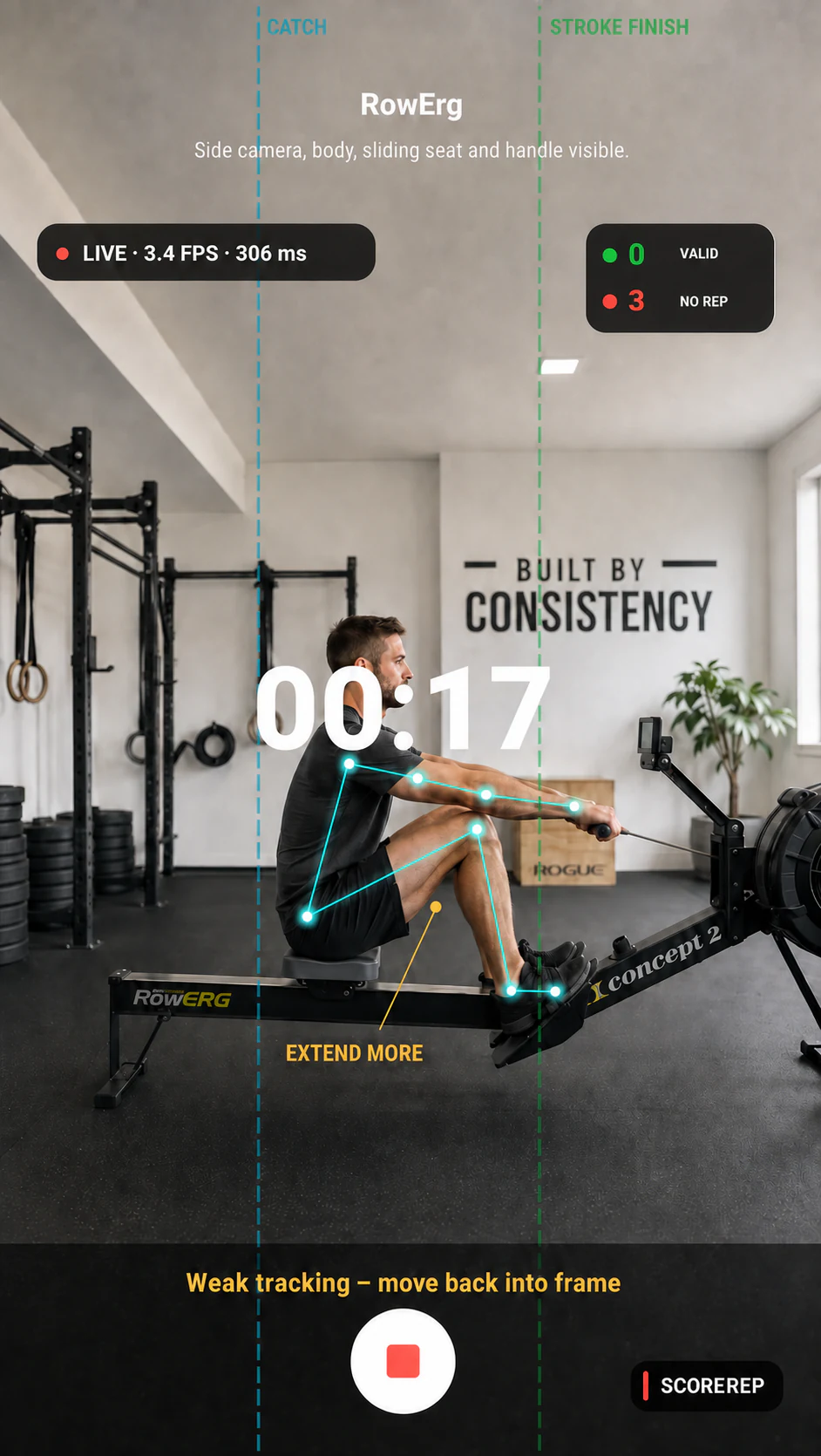
How does an app count reps?
A rep counter does not watch the whole body and decide that a repetition happened. It follows one landmark per station — the hips for a burpee, the wrists for a snatch, the shoulders for a pull-up — and counts complete cycles of that one signal.
Each set gets two thresholds of its own, placed 28% to 30% of the set’s own range in from the top and the bottom of the movement. A cycle counts only when the signal leaves its resting position, crosses both thresholds and comes back. A half rep that turns around between them, or a twitch at the top, never crosses both, so it is not counted at all — not even as a no-rep.
Two more limits stop noise from becoming reps. The signal has to travel a minimum distance within the cycle, 1.5% to 10% of the frame depending on the station, and a new rep cannot complete sooner than the station’s minimum rep time after the last one. The thresholds adapt to the athlete’s own range; the minimum travel does not, which is why a phone placed too far away can miss reps.
Valid rep or no-rep: what happens after a cycle is counted
A counted cycle is not yet a valid rep. 40 of the 41 stations declare standards that every rep has to show — squat depth, a full overhead position, elbow lockout, a full hang, feet off the floor — and each cycle is checked against them using only the frames inside that cycle. A clearly observed miss turns the cycle into a no-rep, with the reason attached. A rep that takes longer than the station allows, or travels far less or far more than the movement plausibly can, is a no-rep too.
Evidence the camera could not take is treated differently from evidence that a rep failed. If the relevant joints are poorly visible, or the reading sits too close to the threshold to call, the rep is counted and marked as uncertain rather than thrown away. Joint angles are only judged from a side or oblique view in the browser counter: a knee or elbow angle seen head-on is foreshortened, so from the front it is reported as not verifiable instead of as a fault.
Rep counter rules for all 41 stations
Travel is measured as a share of the video frame, not in centimetres, and angles are measured at the joint: 180° is a fully straight arm or leg, so a smaller knee angle is a deeper position. Select a station for its full movement page where one exists.
| Station | One counted cycle | A no-rep unless the rep shows | Also a no-rep if | Accepted camera views |
|---|---|---|---|---|
| Air Squats | Hips down, then back up, travelling at least 5% of the frame; no sooner than 0.45 s after the last rep | Hip below the knee (knee angle 110° or less); wrists never above the shoulders; knees straight (160° or more); feet on the floor | If it takes longer than 8 s, or its travel is outside 8%–30% of the frame | Side and front; landmarks at least 40% visible |
| Assault Bike | Wrists forward and back, one full cycle, travelling at least 5% of the frame; no sooner than 0.35 s after the last rep | Feet on the floor | If it takes longer than 5 s, or its travel is outside 6%–35% of the frame | Side; landmarks at least 40% visible |
| Back Squat | Hips down, then back up, travelling at least 3.5% of the frame; no sooner than 0.7 s after the last rep | Hip below the knee (knee angle 110° or less); wrists never above the shoulders; knees straight (160° or more); feet on the floor | If it takes longer than 15 s | Side and 45° oblique; landmarks at least 40% visible |
| Bar Facing Burpees | Hips down, then back up, travelling at least 10% of the frame; no sooner than 0.8 s after the last rep | Feet off the floor | If it takes longer than 10 s, or its travel is outside 15%–55% of the frame | Side and front; landmarks at least 40% visible |
| Bar Muscle-up | Shoulders up, then back down, travelling at least 4% of the frame; counted as soon as they reach the top; no sooner than 0.8 s after the last rep | No deep squat (knee angle stays above 110°); elbows bent to 115° or less; elbows locked out (150° or more); a full hang, shoulders below the hands; shoulders above the hands | If it takes longer than 12 s | Side and 45° oblique; landmarks at least 38% visible |
| Bike Erg | The knee nearest the camera up and down, one full cycle, travelling at least 4% of the frame; no sooner than 0.35 s after the last rep | Feet on the floor | If it takes longer than 4 s, or its travel is outside 5%–30% of the frame | Side; landmarks at least 40% visible |
| Box Jump | Hips up, then back down, travelling at least 6% of the frame; no sooner than 0.65 s after the last rep | Wrists never above the shoulders; knees straight (155° or more); feet off the floor | If it takes longer than 10 s, or its travel is outside 8%–40% of the frame | Side and 45° oblique; landmarks at least 40% visible |
| Box Jump Overs | Hips up, then back down, travelling at least 6% of the frame; no sooner than 0.6 s after the last rep | Wrists never above the shoulders; feet off the floor | If it takes longer than 8 s, or its travel is outside 10%–45% of the frame | Side; landmarks at least 40% visible |
| Burpee Broad Jump | Hips down, then back up, travelling at least 0.3 torso lengths; with the hips also moving 5% of the frame across it; no sooner than 1 s after the last rep | Feet off the floor | If it takes longer than 12 s, or its travel is outside 0.4–2.5 torso lengths | Side; landmarks at least 40% visible |
| Burpees | Hips down, then back up, travelling at least 10% of the frame; no sooner than 0.8 s after the last rep | Nothing beyond the complete cycle | If it takes longer than 10 s | Side and front; landmarks at least 40% visible |
| Burpees Over The Bar | Hips down, then back up, travelling at least 10% of the frame; no sooner than 0.8 s after the last rep | Feet off the floor | If it takes longer than 10 s, or its travel is outside 15%–55% of the frame | Side and front; landmarks at least 40% visible |
| Chest-to-Bar | Shoulders up, then back down, travelling at least 4% of the frame; no sooner than 0.5 s after the last rep | No deep squat (knee angle stays above 110°); wrists above the shoulders; elbows bent to 105° or less; elbows locked out (150° or more); a full hang, shoulders below the hands | If it takes longer than 8 s, or its travel is outside 5%–30% of the frame | Side and front; landmarks at least 40% visible |
| Clean & Jerk | Wrists up, then back down, travelling at least 10% of the frame; no sooner than 1.1 s after the last rep | Wrists above the shoulders; knees straight (160° or more); elbows locked out (155° or more); knees bent to 155° or less at some point; an overhead catch with knees bent to 155° or less | If it takes longer than 16 s, or its travel is outside 12%–65% of the frame | Side and 45° oblique; landmarks at least 40% visible |
| Deadlift | Wrists up, then back down, travelling at least 7% of the frame; no sooner than 0.65 s after the last rep | Wrists never above the shoulders; knees straight (155° or more) | If it takes longer than 12 s, or its travel is outside 8%–45% of the frame | Side and 45° oblique; landmarks at least 40% visible |
| Double Unders | Ankles up, then back down, travelling at least 1.5% of the frame; no sooner than 0.2 s after the last rep | No deep squat (knee angle stays above 100°); feet off the floor | If it takes longer than 4 s, or its travel is outside 2%–12% of the frame | Side and front; landmarks at least 40% visible |
| Dumbbell Snatch | Wrists up, then back down, travelling at least 8% of the frame; no sooner than 0.5 s after the last rep | Wrists above the shoulders; knees straight (155° or more); elbows locked out (150° or more) | If it takes longer than 8 s, or its travel is outside 15%–55% of the frame | Side and front; landmarks at least 40% visible |
| Front Squat | Hips down, then back up, travelling at least 5% of the frame; no sooner than 0.65 s after the last rep | Hip below the knee (knee angle 110° or less); wrists never above the shoulders; knees straight (160° or more); feet on the floor | If it takes longer than 15 s, or its travel is outside 7%–35% of the frame | Side and 45° oblique; landmarks at least 40% visible |
| Handstand Push-up | Shoulders down, then back up, travelling at least 3.5% of the frame; no sooner than 0.5 s after the last rep | No deep squat (knee angle stays above 110°); elbows bent to 100° or less; elbows locked out (155° or more) | If it takes longer than 8 s, or its travel is outside 4%–25% of the frame | Side and front; landmarks at least 35% visible |
| Hang Power Clean | Wrists up, then back down, travelling at least 6% of the frame; no sooner than 0.55 s after the last rep | No deep squat (knee angle stays above 110°); wrists never above the shoulders; knees straight (155° or more) | If it takes longer than 10 s, or its travel is outside 7%–45% of the frame | Side and 45° oblique; landmarks at least 40% visible |
| Hang Power Snatch | Wrists up, then back down, travelling at least 9% of the frame; no sooner than 0.6 s after the last rep | No deep squat (knee angle stays above 110°); wrists above the shoulders; knees straight (155° or more); elbows locked out (155° or more) | If it takes longer than 10 s, or its travel is outside 10%–60% of the frame | Side and 45° oblique; landmarks at least 40% visible |
| Kettlebell Swing | Wrists up, then back down, travelling at least 8% of the frame; no sooner than 0.45 s after the last rep | Wrists above the shoulders; knees straight (155° or more); elbows locked out (150° or more) | If it takes longer than 8 s, or its travel is outside 10%–60% of the frame | Side and 45° oblique; landmarks at least 40% visible |
| Overhead Squat | Hips down, then back up, travelling at least 5% of the frame; no sooner than 0.8 s after the last rep | Hip below the knee (knee angle 110° or less); wrists above the shoulders; knees straight (160° or more); elbows locked out (155° or more); feet on the floor | If it takes longer than 18 s, or its travel is outside 7%–35% of the frame | Side and 45° oblique; landmarks at least 40% visible |
| Pistol Squat | Hips down, then back up, travelling at least 6% of the frame; no sooner than 0.8 s after the last rep | Hip below the knee (knee angle 105° or less); knees straight (155° or more); one leg bent to 110° or less while the other stays at 145° or more; feet on the floor | If it takes longer than 18 s, or its travel is outside 8%–40% of the frame | Side and 45° oblique; landmarks at least 40% visible |
| Power Clean | Wrists up, then back down, travelling at least 7% of the frame; no sooner than 0.65 s after the last rep | No deep squat (knee angle stays above 110°); wrists never above the shoulders; knees straight (155° or more) | If it takes longer than 10 s, or its travel is outside 8%–50% of the frame | Side and 45° oblique; landmarks at least 40% visible |
| Power Snatch | Wrists up, then back down, travelling at least 10% of the frame; no sooner than 0.7 s after the last rep | No deep squat (knee angle stays above 110°); wrists above the shoulders; knees straight (155° or more); elbows locked out (155° or more) | If it takes longer than 10 s, or its travel is outside 12%–65% of the frame | Side and 45° oblique; landmarks at least 40% visible |
| Pull-ups | Shoulders up, then back down, travelling at least 4% of the frame; no sooner than 0.5 s after the last rep | No deep squat (knee angle stays above 90°); wrists above the shoulders; elbows bent to 115° or less; elbows locked out (150° or more); a full hang, shoulders below the hands | If it takes longer than 8 s, or its travel is outside 6%–30% of the frame | Side and front; landmarks at least 40% visible |
| Push Jerk | Wrists up, then back down, travelling at least 7% of the frame; no sooner than 0.55 s after the last rep | No deep squat (knee angle stays above 110°); wrists above the shoulders; knees straight (160° or more); elbows locked out (155° or more); knees bent to 155° or less at some point; an overhead catch with knees bent to 155° or less | If it takes longer than 12 s, or its travel is outside 8%–50% of the frame | Side and 45° oblique; landmarks at least 40% visible |
| Push Press | Wrists up, then back down, travelling at least 7% of the frame; no sooner than 0.5 s after the last rep | No deep squat (knee angle stays above 110°); wrists above the shoulders; knees straight (160° or more); elbows locked out (155° or more); knees bent to 155° or less at some point; overhead with the knees straighter than 150°; feet on the floor | If it takes longer than 10 s, or its travel is outside 8%–48% of the frame | Side and 45° oblique; landmarks at least 40% visible |
| Push-ups | Shoulders down, then back up, travelling at least 2.5% of the frame; no sooner than 0.45 s after the last rep | No deep squat (knee angle stays above 90°); wrists never above the shoulders; elbows bent to 100° or less; elbows locked out (155° or more); feet on the floor | If it takes longer than 8 s, or its travel is outside 3%–20% of the frame | Side; landmarks at least 40% visible |
| Ring Dip | Shoulders down, then back up, travelling at least 3% of the frame; no sooner than 0.45 s after the last rep | No deep squat (knee angle stays above 110°); wrists never above the shoulders; elbows bent to 100° or less; elbows locked out (155° or more); shoulders above the hands | If it takes longer than 10 s, or its travel is outside 3.5%–25% of the frame | Side, 45° oblique and front; landmarks at least 38% visible |
| Ring Muscle-up | Shoulders up, then back down, travelling at least 8% of the frame; no sooner than 0.9 s after the last rep | No deep squat (knee angle stays above 110°); elbows bent to 115° or less; elbows locked out (150° or more); a full hang, shoulders below the hands; shoulders above the hands | If it takes longer than 14 s, or its travel is outside 10%–45% of the frame | Side and 45° oblique; landmarks at least 38% visible |
| Romanian Deadlift | Wrists down, then back up, travelling at least 6% of the frame; no sooner than 0.7 s after the last rep | No deep squat (knee angle stays above 110°); wrists never above the shoulders; knees straight (150° or more); feet on the floor | If it takes longer than 15 s, or its travel is outside 7%–40% of the frame | Side and 45° oblique; landmarks at least 40% visible |
| RowErg | Hands, shoulders and hips forward and back, one full cycle, travelling at least 10% of the frame; no sooner than 0.7 s after the last rep | Wrists never above the shoulders; knees straight (155° or more); feet on the floor | If it takes longer than 8 s, or its travel is outside 12%–55% of the frame | Side; landmarks at least 40% visible |
| Sit-ups | Shoulders up, then back down, travelling at least 4% of the frame; no sooner than 0.4 s after the last rep | Knees bent to 130° or less at some point; feet on the floor | If it takes longer than 8 s, or its travel is outside 5%–35% of the frame | Side; landmarks at least 40% visible |
| SkiErg | Wrists down, then back up, travelling at least 10% of the frame; no sooner than 0.55 s after the last rep | Wrists above the shoulders; feet on the floor | If it takes longer than 6 s, or its travel is outside 12%–60% of the frame | Side and 45° oblique; landmarks at least 40% visible |
| Squat Clean | Wrists up, then back down, travelling at least 7% of the frame; no sooner than 0.85 s after the last rep | Hip below the knee (knee angle 110° or less); wrists never above the shoulders; knees straight (160° or more) | If it takes longer than 12 s, or its travel is outside 8%–50% of the frame | Side and 45° oblique; landmarks at least 40% visible |
| Squat Snatch | Wrists up, then back down, travelling at least 10% of the frame; no sooner than 0.9 s after the last rep | Hip below the knee (knee angle 110° or less); wrists above the shoulders; knees straight (160° or more); elbows locked out (155° or more) | If it takes longer than 12 s, or its travel is outside 12%–65% of the frame | Side and 45° oblique; landmarks at least 40% visible |
| Strict Press | Wrists up, then back down, travelling at least 7% of the frame; no sooner than 0.55 s after the last rep | No deep squat (knee angle stays above 110°); wrists above the shoulders; elbows locked out (155° or more); knees never bent to 150° or less; feet on the floor | If it takes longer than 12 s, or its travel is outside 8%–45% of the frame | Side, 45° oblique and front; landmarks at least 40% visible |
| Thrusters | Hips down, then back up, travelling at least 5% of the frame; no sooner than 0.55 s after the last rep | Hip below the knee (knee angle 110° or less); wrists above the shoulders; knees straight (160° or more); elbows locked out (155° or more); feet on the floor | If it takes longer than 8 s | Side and front; landmarks at least 40% visible |
| Toes-to-Bar | Hips up and down, one full cycle, travelling at least 5% of the frame; no sooner than 0.55 s after the last rep | Wrists above the shoulders; feet up to the line of the hands; a full hang, shoulders below the hands | If it takes longer than 8 s, or its travel is outside 6%–35% of the frame | Side and front; landmarks at least 40% visible |
| Wall Balls | Hips down, then back up, travelling at least 5% of the frame; no sooner than 0.55 s after the last rep | Hip below the knee (knee angle 110° or less); wrists above the shoulders; knees straight (155° or more); feet on the floor | If it takes longer than 8 s, or its travel is outside 7%–35% of the frame | Side and front; landmarks at least 40% visible |
Why a rep didn’t count
Almost every missing rep has one of four causes, and each is tied to a specific condition in the station’s config. A whole set rejected for the same reason is far more often the camera than the athlete, so check the framing before changing the movement.
- The identity check failed. Before counting, the whole clip has to look like the selected station: arms overhead in a station that forbids it, a deep squat where none is allowed, travelling across the floor in an in-place station, or a required position never seen at all. A clip that fails gets no count at all, rather than a count against the wrong rules.
- The movement was too small. The whole clip has to move the station’s main landmark by 2% to 12% of the frame, and each cycle has to travel the station’s minimum. A camera too far away makes every movement small, and a partial cycle is never counted.
- The camera view was not accepted. Each station lists the views it trusts, and the most common view in the clip has to be one of them. Only 14 of the 41 stations accept a front-on camera; for the rest, film from the side or at 45°.
- Visibility was too low. The athlete’s landmarks have to be visible across the clip to the station’s level, 35% to 40% depending on the station. Backlighting, loose clothing, equipment in front of a joint or a crop at the feet all lower it.
- Fix the framing first — the camera position guide.
| What the result says | The standard behind it | Stations that check it |
|---|---|---|
| Not deep enough — the hip did not drop below the knee | Hip below the knee | 9 stations |
| A deep squat was detected in a movement that forbids one | No deep squat | 16 stations |
| Full overhead extension was not reached | Wrists above the shoulders | 16 stations |
| Arms went overhead in a movement that forbids it | Wrists never above the shoulders | 13 stations |
| The knees were not fully extended | Knees straight | 22 stations |
| No single-leg support was detected at the bottom | One leg bent, the other straight | Pistol Squat |
| The feet did not reach the hands/bar | Feet up to the line of the hands | Toes-to-Bar |
| The elbows were not fully flexed | Elbows bent | 7 stations |
| The elbows were not fully extended | Elbows locked out | 18 stations |
| The leg dip was not reached | Knees bent at some point in the rep | Clean & Jerk, Push Jerk, Push Press and Sit-ups |
| A leg dip was detected in a movement that must stay strict | Knees never bent | Strict Press |
| The full hang position was not reached | A full hang, shoulders below the hands | Bar Muscle-up, Chest-to-Bar, Pull-ups, Ring Muscle-up and Toes-to-Bar |
| The transition above the hands was not reached | Shoulders above the hands | Bar Muscle-up, Ring Dip and Ring Muscle-up |
| The overhead catch with bent knees was not reached | An overhead catch with bent knees | Clean & Jerk and Push Jerk |
| A dipped catch was detected — that is a jerk, not a press | An overhead finish with straight knees | Push Press |
| No airborne phase was detected | Feet off the floor | Bar Facing Burpees, Box Jump, Box Jump Overs, Burpee Broad Jump, Burpees Over The Bar and Double Unders |
| An airborne phase was detected in a movement that forbids one | Feet on the floor | 16 stations |
What the rep counter cannot judge
It is not a competition judge. An event standard can require things a camera cannot see from one phone: a ball touching a target, a chest touching the floor, a bar touched with the hips, a precise box height. The counter checks the body positions it can measure and leaves the rest to a human.
Two-dimensional pose estimation measures visible joint positions. It does not measure force, load or medical safety, and any count is only as good as the clip it came from. The honest test is a set you have already counted yourself: run it through the demo and compare.