How do I keep wall ball depth honest when I am tired?
Depth is the first thing to disappear in a long set, and it disappears gradually enough that the athlete rarely notices. Film from the side so the hip crease and knee are both visible at the catch, then compare the tenth rep with the fiftieth in the same clip. If the bottom position has crept upward, the answer is almost never to try harder: it is to break the set before the failure point, keep the ball closer to the chest so the descent is not fighting the load, and let the receiving position absorb the ball into the next squat instead of stopping and re-squatting. Athletes who set an intentional rhythm — say sets of fifteen with a three-breath break — usually finish faster than those who go unbroken until the standard collapses and the no-reps begin.
What ScoreRep reviews
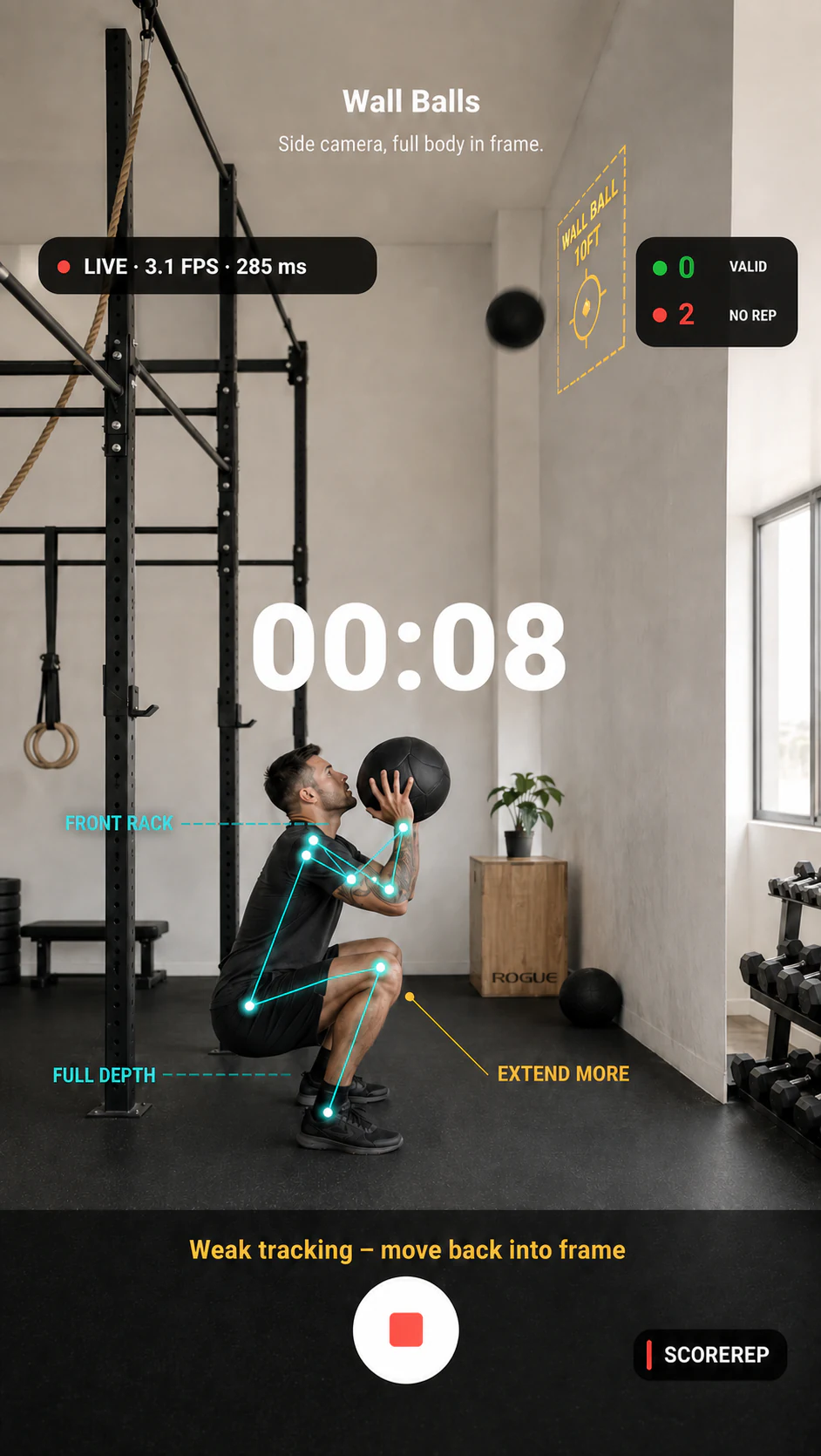
The wall-ball rubric checks that a clear squat and overhead throw are visible before scoring the movement. It then evaluates squat depth, arm extension during the throw, concentric timing, cadence and symmetry when the view supports it.
The target and ball should remain visible. If either leaves the frame, the system has less evidence for the complete movement.
- Squat depth
- Extension into the throw
- Timing of the upward drive
- Cadence across repetitions
- Visible symmetry
Does this wall ball rep count?
ScoreRep answers that in two separate steps. First, the clip has to read as a wall ball at all: every check in the table below has to pass, and a reading the camera could not take counts as a fail, never as a pass. A clip that fails is returned unranked with the reason attached, rather than scored low against the wrong rubric, and no template can override a failed check.
Second, the scoring criteria award points. Falling short of a full-marks threshold costs points, not the rep. Every number here is read from version 1 of the wall ball rubric, the same file the scoring engine runs.
- Compare the wall ball standard with the other 29 movements on the movement standards page.
- How the rep counter decides between a valid rep and a no-rep, station by station.
| Reading | Has to be | Otherwise rejected because |
|---|---|---|
| Vertical travel of the hips across the rep | 0.08 or more | no squat was detected |
| Whether the hip crease passes below the knee | yes | the hip crease never passes below the knee |
| Whether the hands reach an overhead position | yes | the ball never reaches the overhead target |
| Vertical travel of the wrists across the rep | 0.15 or more | the ball did not travel far enough, which reads as a thruster rather than a wall ball |
| Elbow angle in the starting position | 90° or more | the ball is not held at chest level at the start |
Which wall ball faults cost the most reps?
Wall balls punish inefficiency more than most movements because the cycle repeats so quickly. The faults below cost either reps on the scoreboard or energy that ends the set early.
- Catching the ball high and stopping — the descent restarts from zero every rep. Receive the ball while already moving into the next squat.
- Elbows drifting wide at the catch — the arms carry load the legs should. Keep the ball close with elbows under it.
- Throwing with the arms instead of finishing the leg drive — the ball falls short of the target and pace drops fast.
- Depth fading before the throw quality does — usually the earliest visible sign that the set is going badly.
- Standing too far from the wall so the ball travels forward as well as up, adding distance to every rep.
Choose a view that shows athlete and target
Use a side or oblique angle far enough away to capture the bottom of the squat and the full throwing path. The camera must not crop the target area or the athlete feet.
For long sets, make sure other athletes will not repeatedly cross the pose area.
How should I read the cadence graph across a long set?
Cadence tells a story that a total rep count hides. A set that starts at a rep every two seconds and holds it to the end was paced well, even if the total was modest. A set that opens far faster than it finishes usually cost more than it gained: the early reps banked a few seconds, the late reps gave them back with interest, and the quality of movement in between fell away. Look for the point where the interval between reps starts to grow steadily rather than the single slowest rep, because that inflection is where the pacing decision belongs on the next attempt. Then check the depth evidence around that same moment. A faster cadence is only useful when the movement stays recognisable and trackable; a high count made of shallow reps is not a better result.
How do ball weight and target height change what you should film?
Both change the movement enough to change what the camera needs to see. A heavier ball pulls the torso forward at the bottom and slows the catch, so the frame has to keep the hip crease visible even when the athlete folds further than usual. A higher target moves the throw further overhead and lengthens the flight, so leaving headroom above the athlete matters more than leaving floor space below. A target that is high relative to the athlete also hides an efficiency problem: reps that look strong can still be finishing with the arms because the legs ran out of drive early. Film from a distance that keeps feet, hip, hands and the contact point in one frame at the weight and height you actually train with, and note both numbers alongside the clip.
Agree the standard before you compare
Target height, ball weight and the required depth vary between gyms and competitions. Fix those before comparing two sessions or two athletes, otherwise you are comparing different exercises.