Can you use ChatGPT as a fitness coach?
Yes, for the parts of coaching that are made of language, and no for the parts that are made of observation. A general assistant is genuinely good at drafting a training week around your constraints, explaining why something is programmed, translating a coach’s plan into a checklist, and answering the questions people are embarrassed to ask a human. It is free or cheap, available instantly, and infinitely patient.
What it cannot do is see you. It has no idea whether the squats happened, whether they reached depth, or whether the twelve reps you reported were twelve reps by anyone else’s standard. It also has no memory of your training unless you give it one, and no responsibility for the outcome. Used with those limits in mind it is a useful tool; used as a replacement for a coach it is a confident narrator of a session it never observed.
What it is genuinely good at
The strongest use is as a training assistant rather than a training authority — the work that surrounds coaching rather than coaching itself. Each of these is fast, low-risk and easy to sanity-check yourself.
- Drafting a week around real constraints: four days, ninety minutes, a barbell and a bike.
- Explaining terminology and rationale — what an RPE of eight means, why a deload exists, what a hinge pattern trains.
- Substituting movements when equipment is unavailable or a machine is occupied.
- Turning a plan you already trust into a session checklist, a warm-up or a shopping list.
- Rehearsing questions before a coaching call so the call is spent on decisions rather than definitions.
Where it fails, and why the failure is hard to notice
The failures are not loud. A language model will produce a plausible, well-formatted twelve-week programme with the same confidence whether or not the reasoning behind it holds, and the format itself is persuasive: numbered weeks and precise percentages read as expertise. It will also tend to agree with you. Tell it your plan is good and it will usually find reasons that it is, which is the opposite of what a coach is for.
The deeper problem is the missing feedback loop. Every coaching decision that matters — add load, hold, back off, fix the movement before adding anything — depends on knowing what happened last session. The assistant knows only what you typed, and what you type is a summary written by the person who was inside the effort. Nobody logs "the last two sets were above parallel", because nobody feels that from underneath a bar.
It also cannot assess safety in any meaningful sense. It does not know your injury history unless you tell it, cannot see a movement compensation, and should never be the thing that decides whether pain is worth training through.
How to prompt it so the plan is usable
Most bad AI training plans are bad because the prompt described a wish rather than a situation. Give it the constraints a coach would ask for in the first five minutes, and ask for rules rather than a fixed calendar, because a static twelve-week block cannot survive contact with a missed week.
A prompt worth reusing contains six things: your training history and current numbers, the days and time you genuinely have, the equipment you can access, your goal with a date attached, any injuries or restrictions, and what happened in the last two weeks. Then ask for progression rules — what to do if a session is missed, if a load feels heavy, or if a rep target is missed — and ask it to state the assumptions it made. The assumptions are usually where you find the mistake.
- Give it your actual numbers, not your aspirational ones.
- Ask for progression and failure rules, not a fixed twelve-week calendar.
- Ask it to list the movement standard for each exercise so you know what you are trying to hit.
- Ask what it assumed, then correct the assumptions and regenerate.
- Ask it to flag anything that should be checked by a coach or clinician rather than answered by a model.
The gap a language model cannot close
Suppose the plan is excellent. It still rests on one unverified assumption: that the training happened the way it was written. Five by five at a given load means nothing if the fifth set was two inches higher than the first, and no amount of prompting fixes that, because the model is reasoning from your summary rather than from your movement.
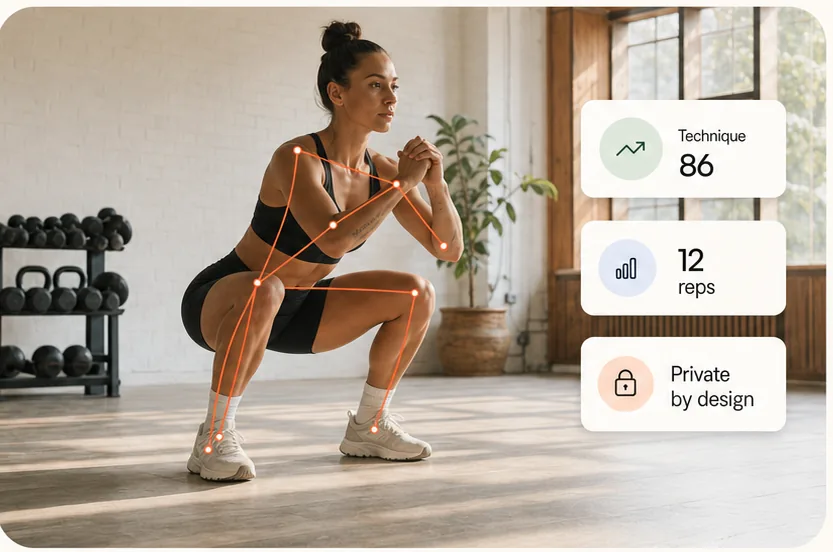
This is where a camera does something a chat window cannot. Filming one set and counting the reps against a movement standard produces the one input the assistant never had: what actually happened. Feed that back into the conversation — the count, the criteria that held, the point in the set where depth started to fade — and the next block is planned on evidence rather than on recall.
A division of labour that works
The setup most likely to survive a training block gives each tool the job it is actually good at. The assistant plans and explains, because language is what it is made of. The camera verifies, because execution is visible and self-reporting is not reliable under fatigue. The human coach judges, because context, risk and responsibility are not automatable — and because someone should be accountable for the decision to add weight.
If you have no coach, the first two still work together, and they are considerably better than either alone. Plan with the assistant, verify one set a week with the camera, and let the evidence rather than the enthusiasm decide what happens next.
Is it safe to train from an AI-written plan?
For a healthy adult doing moderate, familiar training, a well-prompted plan is usually a reasonable starting point, and the most common failure is not danger but drift: volume that creeps, progression that stalls, or a programme that never adapts because nothing ever measured whether it worked.
The risk rises with load, novelty and existing injury. A model cannot examine you, cannot see a compensation pattern and cannot tell whether pain is a warning or a nuisance. Anything involving recent injury, medical conditions, pregnancy, rehabilitation or persistent pain belongs with a qualified professional, and no automated movement score — including ScoreRep’s — is a clearance to load a joint.