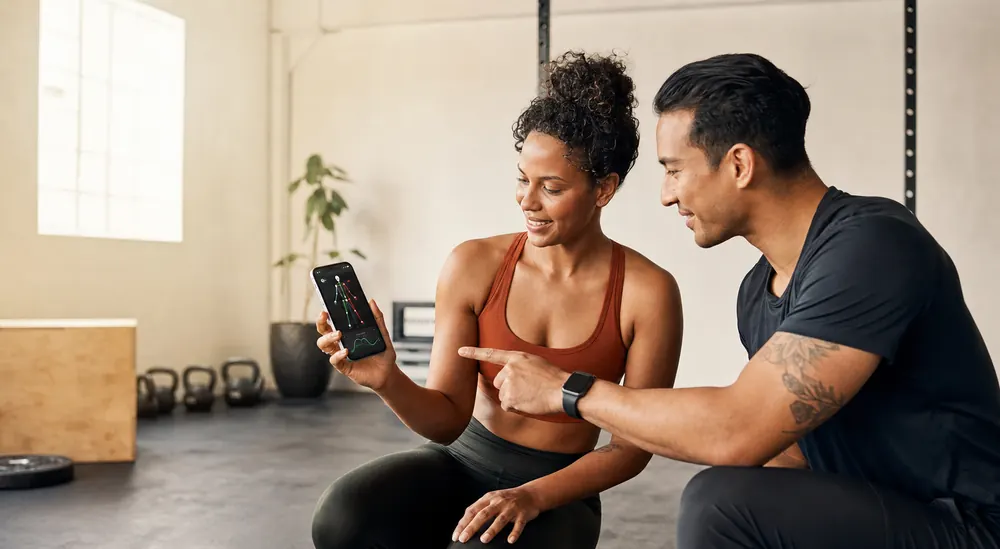
What is the best AI fitness coach?
There is no single best AI fitness coach, because at least five different products are sold under that name and they solve unrelated problems. A programming engine decides what you should train. A conversational coach keeps you accountable to the plan. A nutrition and recovery tracker explains why the plan is not landing. A class platform makes the session easy to follow. A movement-analysis tool checks what actually happened when you trained. Ranking those against each other is like ranking a calendar against a mirror.
The useful question is not which app wins a roundup, it is which of those jobs is currently costing you progress. Most athletes who feel stuck already know what to train; they are losing time somewhere else in the chain. Identify the weak link first, then buy the tool built for it — and accept that you may end up using two.
- Programming and load progression — generates sessions, adjusts volume and intensity over a block.
- Conversational coaching — check-ins, plain-language answers, plans drafted on request.
- Nutrition, sleep and recovery — intake, readiness and training-load context.
- Guided classes and live sessions — instructor-led delivery with structure and pacing.
- Movement analysis and rep verification — what the camera can confirm about execution.
Match the tool to the problem you actually have
The fastest way to choose is to describe your last eight weeks in one sentence and then pick the category that answers it. Each of the patterns below points at a different product, and buying the wrong one usually feels like paying a subscription to be told things you already knew.
- You do not know what to train next — a programming engine earns its price here, especially if your equipment or schedule changes week to week.
- You know what to train and skip it anyway — the constraint is adherence, so accountability and habit features matter more than clever periodisation.
- You train consistently and stopped progressing — look at sleep, food and total training load before blaming the programme.
- You train hard and the movement quality drifts under fatigue — no plan can fix this, because the plan never sees the rep.
- You have a coach and see them rarely — the gap is evidence between sessions, not more programming.
Can AI be used as a fitness trainer?
For part of the job, it already is. Software can build a sensible training week around your equipment, experience and available time, adjust it when you miss a session, explain why a movement is programmed, and remember every session you have logged — which is more than most people manage on their own. For an athlete training alone with no access to coaching, that is a genuine improvement over guessing.
The part it cannot do is the part a trainer does with their eyes. A human trainer watches the third set, sees the depth change, notices the flinch on the left knee that you did not mention, and adjusts the session while it is happening. Almost all AI trainers work from what you type in afterwards, which means the quality of their coaching is capped by the accuracy of your self-report — and self-report degrades exactly when training gets hard.
So the honest answer is that AI can perform the planning, tracking and explaining parts of a trainer’s role today, while the observing and judging parts still need either a person in the room or a camera pointed at the movement.
Which AI is best for the gym floor?
Gym training narrows the question usefully, because a gym adds constraints that a home-workout app never handles well: fixed equipment that may be occupied, barbell loading that must progress in real increments, and a training standard that has to hold across a set rather than for one demonstration rep. Prioritise a tool that knows what equipment you actually have, progresses load in the increments your plates allow, and does something sensible when the rack is busy.
The second thing worth having on a gym floor is verification, because a barbell punishes drift more than a bodyweight circuit does. Depth that quietly shrinks under load, a bar path that starts wandering forward, a lockout that stops being a lockout — those are the failures that turn a good programme into a plateau, and none of them appear in a logged set that says five by five, completed.
Is there a free AI fitness coach?
Yes, and free covers more than it used to. General assistants will draft a training week at no cost. Most subscription coaching apps run a free tier that is genuinely usable for a beginner, usually limited by how much history you can keep or how far the plan adapts. The honest catch is that free tiers are shaped to be outgrown: the limits tend to bite at the point where you start training seriously enough to need the tool.
ScoreRep works the same way and says so plainly. The station demo counts reps from an uploaded clip in your browser with no account at all, so you can test the analysis on your own training before deciding anything. A free account adds eight saved analyses a month with the exercise-specific score and criteria; the paid plan exists for people who analyse more often than that.
What separates a real AI coach from a workout generator
The label is unregulated, so it covers everything from a genuinely adaptive system to a randomiser with a chat window. A short list of questions separates them quickly, and every one of them can be answered during a free trial rather than after three months of billing.
Pay particular attention to what the system is reasoning from. Almost all of them adapt on self-reported input: you tell the app the set felt like an eight out of ten, you tick the session complete, and every future decision is built on that report. Self-reporting is not worthless, but it is the weakest link in the chain and it is rarely disclosed as one.
- Does it adapt, or reshuffle? Ask what changes if you miss a week, and whether anything in the plan actually depends on last session.
- What evidence does it use — self-reported effort, wearable data, or something measured?
- What happens when you deviate? A tool that silently reverts to the template is a spreadsheet.
- Can you export your history, or is a year of training locked inside the subscription?
- Can you test it on your own training before paying, rather than on a demo account?
- Does it claim to detect injury risk or diagnose your body? That is a red flag, not a feature.
- Does it work alongside a human coach, or does it assume it replaced one?
The blind spot almost every AI coach shares
Coaching software is very good at deciding what you should do and very poor at knowing what you did. The plan says five sets of five back squats. You perform them, tick the session complete, and the system records a clean success. It cannot see that the last two sets finished ten centimetres higher than the first, that your cadence collapsed halfway through the set, or that the standard you held in week one quietly stopped being the standard by week six.
That matters more than it sounds, because adaptation compounds. Every future load, every readiness estimate and every progress chart is built on the assumption that the logged work happened as prescribed. Feed unverified execution into an adaptive system for a training block and you get confident recommendations resting on an increasingly inaccurate record of your training.
This is the layer a camera can close, and it is the one part of coaching that self-reporting cannot cover. It is also narrow: video can confirm whether the movement met a visible standard, and it can show when that standard started to drift across a set. It cannot tell you what to train tomorrow.
Where ScoreRep fits, and where it does not
ScoreRep is not an AI fitness coach and does not try to be one. It does not write your programme, plan your food or message you about your streak. It uses your phone camera to verify execution: counting valid reps and no reps live, scoring recorded sets against exercise-specific criteria, and keeping the results so two sessions can be compared honestly.
It works alongside whatever coaching app or human coach you already use. If your programme comes from an app, ScoreRep tells you whether the sets it prescribed were performed to the standard it assumed. If your programme comes from a coach you see fortnightly, it gives you both something concrete to look at in between.
- Live valid and no-rep counting with the movement standard shown on screen.
- Exercise-specific technique review with a criterion breakdown, not one generic form score.
- Structured evidence a coach can review between sessions.
- Live challenges for gyms and remote training groups.
- A free pacing calculator for planning hybrid race splits.
How to combine an AI coach with movement evidence
The practical setup takes about five minutes a week and does not require abandoning the app you already pay for. Keep the coaching tool for programming and adherence, and add one filmed set as the reality check on top of it.
Choose the movement that carries the most risk of drifting — usually the heaviest lift of the week or the station that decides a long workout — and film one set of it from the same marked phone position each time. Review the result against the video rather than trusting a number in isolation, and change one thing before the next attempt. If a coach is involved, send them the analysis before the conversation so the call starts from shared evidence instead of from memory.
- Set the camera once, properly, and mark the position so repeat clips stay comparable.
- Film the same lift at a similar load each week rather than whichever set felt best.
- Compare the fatigued reps with the opening reps in the same clip, not two sessions apart.
- Take the recording, not just the score, to whoever coaches you.
Can an AI fitness coach replace a human coach?
For some jobs it already has. Software is available at six in the morning, remembers every session you have ever logged, never gets bored of the same question and costs a fraction of weekly one-to-one coaching. For an athlete with no access to a coach at all, a competent app is a large improvement over guessing.
For other jobs the gap is still wide, and honest products say so. A coach carries context that no camera or questionnaire captures: your injury history, what is happening outside the gym, what you are actually training for, how much risk is sensible this month, and whether the pain you mentioned in passing needs a clinician rather than a deload. Software produces information; a coach makes judgements and takes responsibility for them.
Treat automated movement feedback as educational information about visible movement. It does not measure force, tissue loading or medical safety, and no score should be read as clearance to add weight. Persistent pain is a question for a qualified professional.
What should an AI fitness coach cost?
Most consumer coaching apps sit between a free tier and roughly the price of a couple of coffees a month, while hybrid services that put a human behind the software cost several times more. The spread inside that range says very little about quality, so judge value by whether the tool changed a decision you make: a plan you followed rather than skipped, a load you adjusted for a real reason, a technique fault you fixed because you finally saw it.
A subscription that produces charts you never act on is expensive at any price. Test each candidate on your own training for a fortnight, keep the one that changed something, and cancel the rest without ceremony.